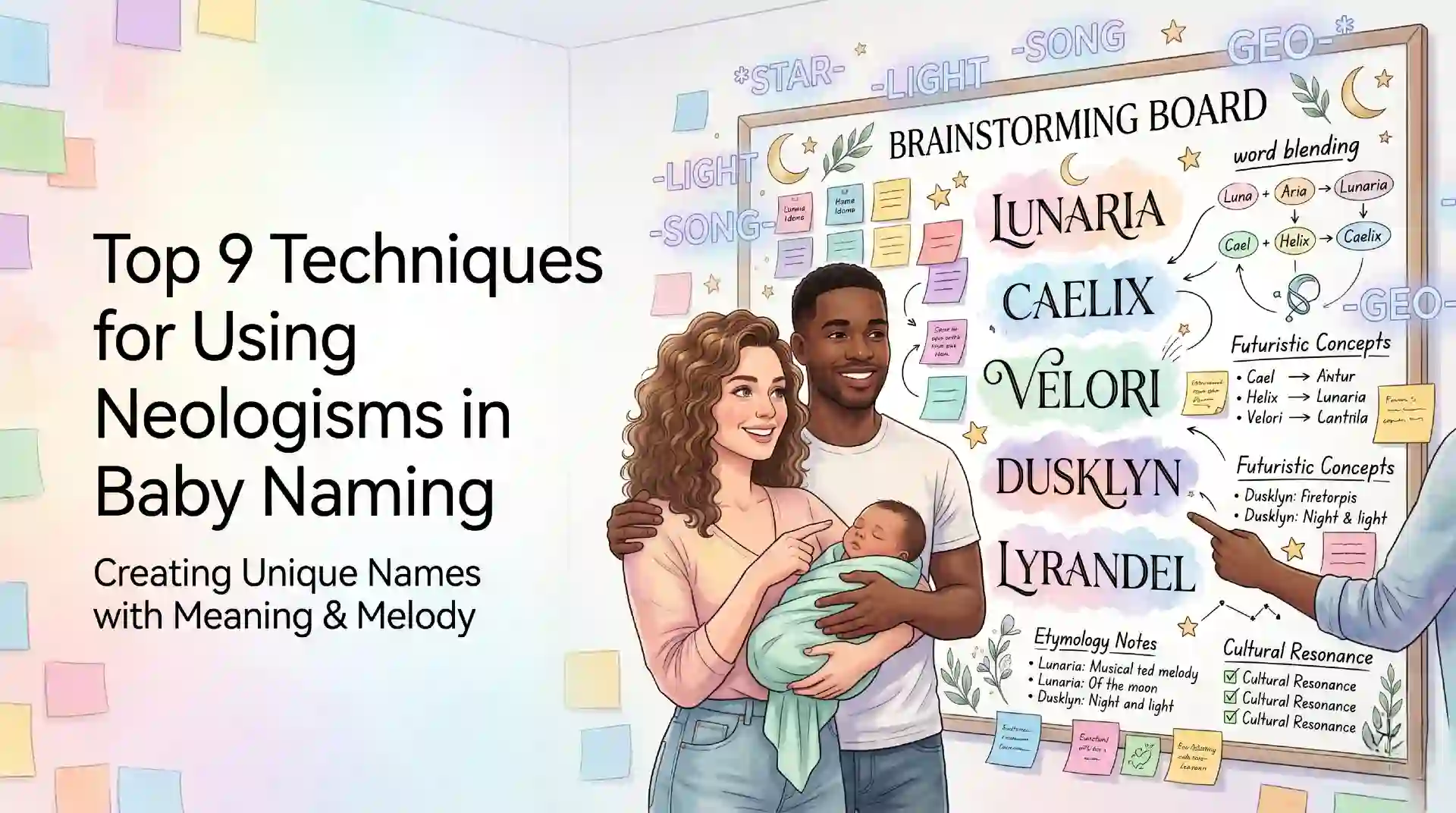
What if your baby’s name didn’t exist until you created it?
That’s exactly what thousands of parents are doing right now. They’re skipping the top-100 lists and inventing something entirely new. Something that sounds beautiful, feels personal, and can’t be found on a keychain at the gift shop. These invented names are called neologisms a fancy word (from linguistics) for newly created words or names.
In this guide, you’ll discover the top 9 techniques for using neologisms in baby naming. Whether you want a futuristic baby name, a creative mashup of family names, or something that just sounds right, these methods will get you there.
What Is a Neologism? (And Why It Works for Baby Naming)
A neologism is a newly coined word or phrase. It didn’t exist before someone made it up, and it caught on. Think ‘Google,’ ‘selfie,’ or ‘podcast.’ They were invented, then adopted.
The same idea applies to baby names. Parents are increasingly moving away from traditional names because they want something that truly belongs to their child. According to Social Security Administration data, parents today are choosing more unique names than at any point in recorded U.S. history. Over 60% of the top 1,000 baby names in 2023 were first-time entries.
That’s not a trend. That’s a shift.
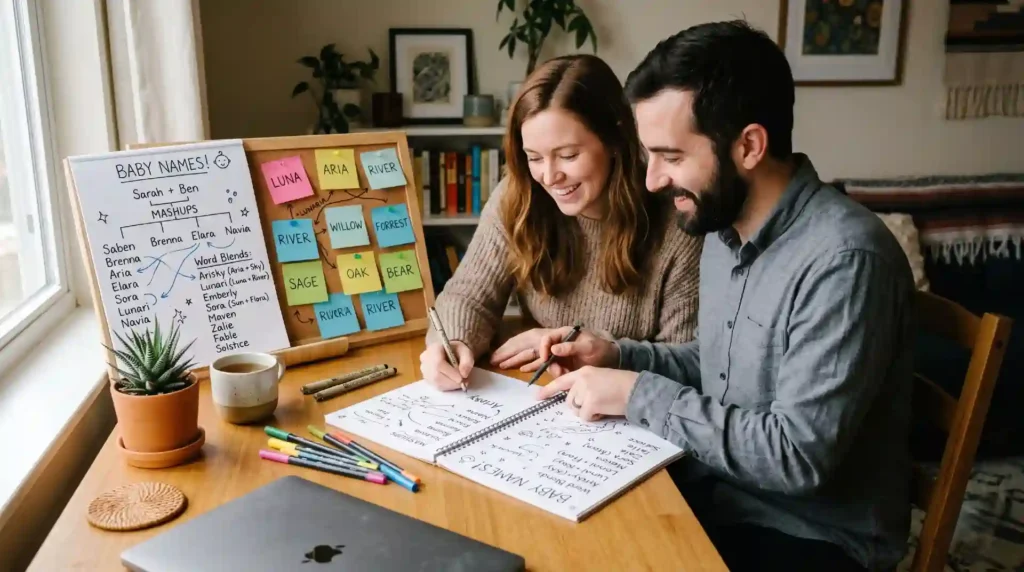
Technique 1: Word Blending (Portmanteau Names)
This is one of the most popular baby name creation techniques right now and it’s easier than it sounds.
A portmanteau (por-man-TOH) blends two words into one new word. ‘Brunch’ is breakfast + lunch. ‘Smog’ is smoke + fog. You can do the same with names or meaningful words.
How to Do It
- Pick two words you love — a season, a feeling, a place, a color.
- Write them out and look for overlapping letters or sounds.
- Merge them naturally, keeping the flow smooth and easy to say.
Examples
- Aurora + Laine = Aurolaine
- River + Elise = Riverise
- Luna + Aria = Lunaria
- Sage + Ember = Sembe
Technique 2: Parent Name Mashups
One of the most meaningful ways to create a unique baby name is to combine the parents’ names. This tradition has roots in many cultures, but today’s parents are putting a modern spin on it.
I’ve seen this technique create some genuinely beautiful results. A couple I know Marcus and Eliana — named their daughter Marceli. It sounds elegant, it’s completely original, and it carries a family story inside it.
How to Do It
- Write both parents’ first names.
- Try taking the first half of one and the second half of the other.
- Experiment with different split points until you get something that sounds right.
Examples
- James + Olivia = Joliv or Olivames
- Noah + Serena = Noena or Seroah
- David + Camille = Davielle or Camilid
Technique 3: Nature-Inspired Invented Names
Nature has been inspiring names for centuries. But instead of picking an existing nature name like River or Ivy, you can invent one from natural imagery.
Think about textures, colors, movements, and sounds in nature. Then turn them into a name.
Examples of Invented Nature Names
- Thornlei – inspired by a thorned meadow
- Dusklyn – the feeling of dusk in a quiet landscape
- Coralen – coral + len (a suffix meaning ‘small lake’ in Welsh)
- Mosswyn – moss + wyn (meaning ‘fair’ in Welsh)
Technique 4: Sound Borrowing from Other Languages
Some of the most aesthetic baby names come from borrowing sounds from other languages not full words, just syllables and phonetic patterns.
This is how names like Zara, Lyra, Kiran, and Seren became popular in English-speaking countries. They’re real words in other languages, but in English, they feel fresh and invented.
Phonetic Patterns Worth Borrowing
- Japanese: soft sounds like -mi, -ko, -ri, -na (Lumiko, Haruna)
- Arabic: flowing sounds like -aya, -eem, -ara (Sareem, Tanaya)
- Gaelic: breath-like sounds like -aidh, -eith, -eil (Lorneil, Braidhe)
- Swahili: open vowels -ari, -ema, -olu (Temari, Solema)
Technique 5: Literary and Fantasy-Inspired Names
Fantasy and sci-fi authors are some of the best neologism creators in history. Tolkien invented entire languages. Ursula Le Guin crafted names that felt mythic and new at the same time.
You don’t need to create a whole world just borrow the technique. Look at what makes fantasy names feel epic: strong consonants, unusual vowel placements, rhythmic syllables.
Tips for Fantasy-Inspired Baby Names
- Use rare letters: X, Z, V, K, Q add uniqueness.
- Avoid too many consonants stacked together it gets hard to say.
- Aim for 2-3 syllables for a name that’s memorable but not exhausting.
- Look at your favorite book or game characters for inspiration, then twist it.
Examples
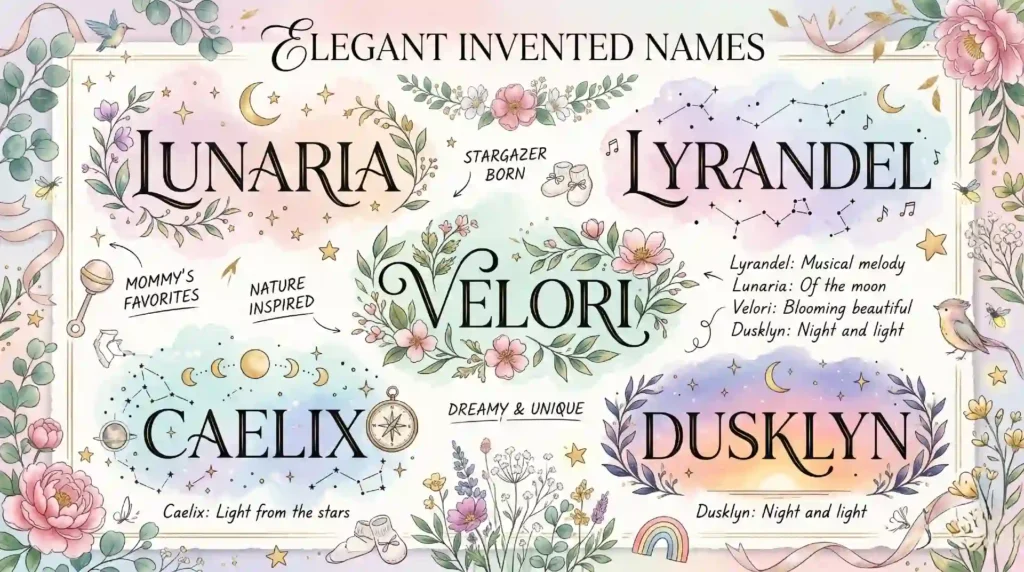
- Lyrandel – inspired by Tolkien-style elvish sounds
- Zevari – strong, short, sci-fi feel
- Eiravyn – soft, magical, mythological
- Caelix – celestial, powerful, unique
Technique 6: Modifying Classic Names
You don’t have to invent from scratch. One of the easiest ways to create original baby names is to take a classic name and tweak it slightly.
Add a letter. Remove a syllable. Swap a vowel. The result can feel both familiar and fresh.
Modification Examples
- Emily → Emilyx, Emylie, Emilara
- James → Jamese, Jaymes, Jamon
- Grace → Graecen, Gracelyn, Gracelie
- Ethan → Ethren, Ethanael, Ethanos
Technique 7: Acronym-Based Names
Here’s a technique most people haven’t thought of. Take the initials of meaningful words and use them to build a name.
Some parents use the initials of values they want to pass on. Others use the letters from meaningful places, events, or people.
How It Works
- Write out 3–5 words that are meaningful to your family.
- Take the first letter of each.
- Arrange the letters into a name that sounds good.
Example
Words: Loyalty, Imagination, Valor, Compassion → LIVC → Livac or Cival
Words: River, Aspen, Ember → RAE → Already a lovely name, or expand to Raewyn or Raeven.
Technique 8: Phonetic Tweaks for a Fresh Feel
This technique is subtle but powerful. You take a name that already sounds beautiful and respell it to give it a new identity.
Phonetic spelling changes the look of a name without changing how it sounds. It makes the name feel custom and original, even if it’s recognizable.
Examples
- Ava → Ayva, Avah, Aevah
- Kai → Kye, Ky, Kaie
- Lily → Lilee, Lili, Lylee
- River → Ryver, Rivyr, Ryvver
Technique 9: Brand-Style Invented Names
Think about how brands like Kodak, Häagen-Dazs, or Spotify were named. They’re invented words designed to sound memorable, feel modern, and carry no baggage from existing meanings.
You can apply branding principles to baby naming. This works especially well for parents who want a futuristic or truly one-of-a-kind name.
Branding Rules Applied to Baby Names
- Keep it under 3 syllables short names are more memorable.
- Make it easy to spell when heard out loud.
- Avoid sounds that are too similar to common negative words.
- Test it: say it in a crowd (‘Hey, [name]!’) and see if it feels right.
Examples of Brand-Inspired Names
- Velori – smooth, modern, gender-neutral
- Nexen – futuristic, strong, unique
- Lumae – soft, aesthetic, memorable
- Zyron – edgy, sci-fi, bold
Frequently Asked Questions
What is a neologism baby name?
A neologism baby name is a completely invented name one that didn’t exist before. Parents create these using techniques like word blending, phonetic tweaks, language sound borrowing, or combining family names. They’re designed to be unique, meaningful, and original.
Is it okay to give your baby a made-up name?
Absolutely. There’s no rule that says names must come from an existing list. Most names were invented at some point. The key is choosing something that sounds dignified, is easy to spell and pronounce, and will serve your child well throughout their life not just in infancy.
How do I make sure my invented baby name sounds good?
Say it out loud repeatedly. Test it in different contexts: calling it across a room, introducing your child in a professional setting, using it with your last name. Ask a few trusted people to say it cold without any prompting and see if they say it the way you intended.
How many syllables should a neologism baby name have?
Two to three syllables tends to be the sweet spot. Names in this range are memorable, easy to call out, and work with most last names. One-syllable invented names can feel too abrupt; four or more syllables can be exhausting to say repeatedly.
Can neologism baby names have a nickname?
Yes, and you should plan for it. Think about what the natural nickname would be. If you name your child Lyrandel, they’ll likely get ‘Lyra’ or ‘Randi.’ Make sure you love the nickname as much as the full name because it will almost certainly get used.
Related Reading on FieldBuzz
- Top 10 Creative Ways to Blend Sibling Names into One
- Best 11 Free Apps to Combine Two Names for a Newborn (2026 Guide)
- Best 14 Gender-Neutral Name Combiners for Modern Parents